
A notice of violation (NOV) from the SCAQMD is avoidable more often than not. Most violations come from a short list of rules, and most of those trace back to routine tasks that slipped. Learn the five rules behind the bulk of NOVs and you can close the gaps before an inspector finds them.
Start with the data.
What the violation data shows
Between 2012 and mid-2015, the SCAQMD issued 2,722 violations. Settlements over that period totaled about $2.5 million, an average of $928.61 per violation, well below most individual settlements.
The value is in the pattern. About 60 percent of those 2,722 violations came from just five rules. Half came from three. And roughly 25 percent traced to a single rule: Rule 203, the requirement to hold a permit to operate.
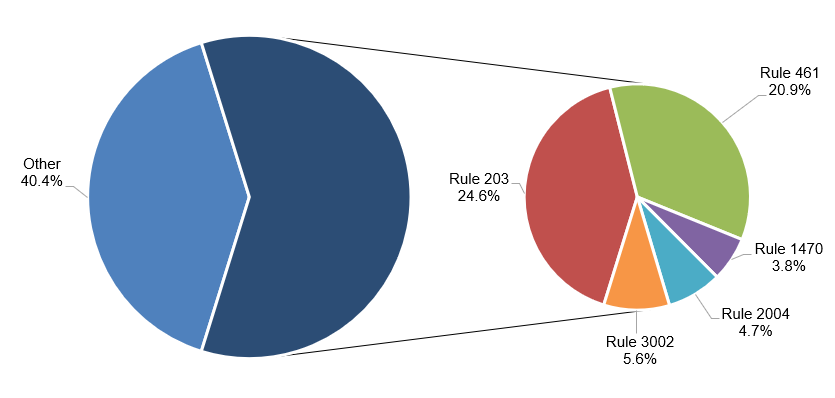
So start with these five rules.
1. Rule 203
Rule 203 is simple, with only two provisions, yet it accounts for roughly 25 percent of the violations the SCAQMD issues. It requires a facility to hold a permit to operate its equipment, and those permits carry compliance conditions printed on the front. Two conditions show up on nearly every permit:
- You must operate your equipment in a manner consistent with the information you provided in your application.
- You must keep your equipment in good operating condition.
These look basic, which is exactly why they get overlooked. Here are two examples from the SCAQMD database.
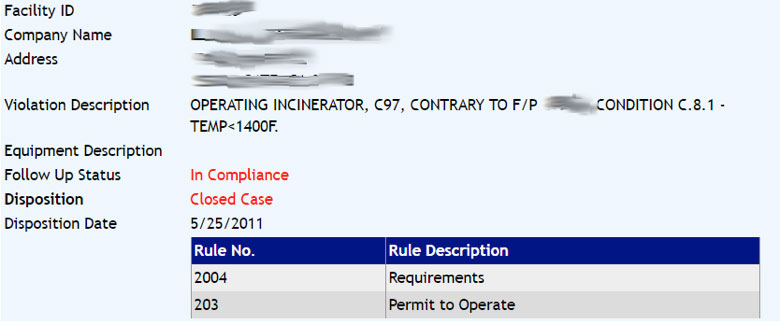
Operating contrary to permit conditions
The facility was operating its equipment contrary to condition C8.1 on its permit:
Equipment not in good operating condition
The facility was operating a tank with a hole:
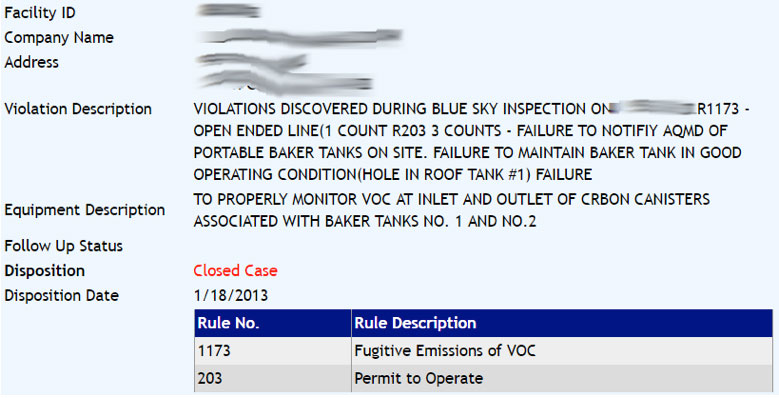 A tank is meant to hold its contents. A hole means it is not in good operating condition: the contents spill, and the tank can emit fugitive emissions.
Solution: Follow your permit conditions and understand what you submitted in your original application. If you're reviewing your conditions now and find a problem, fix it as soon as you can. (See point 3 in 3 best practices for permit conditions.) Talk to the operators who run the equipment day to day, so you know whether what happens in the field matches the permit.
A tank is meant to hold its contents. A hole means it is not in good operating condition: the contents spill, and the tank can emit fugitive emissions.
Solution: Follow your permit conditions and understand what you submitted in your original application. If you're reviewing your conditions now and find a problem, fix it as soon as you can. (See point 3 in 3 best practices for permit conditions.) Talk to the operators who run the equipment day to day, so you know whether what happens in the field matches the permit.
2. Rule 461
Rule 461 applies to facilities that transfer or dispense gasoline, typically retail gas stations. It sets vapor-recovery, operation-and-maintenance, testing, and recordkeeping requirements.
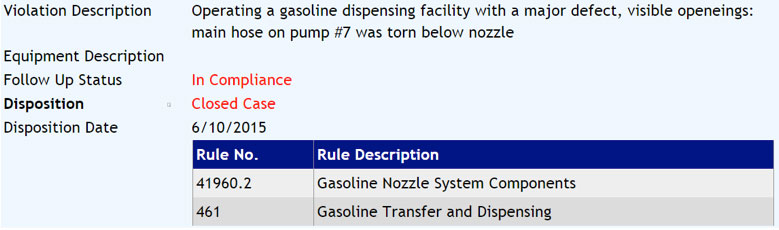
Operating equipment with a major defect
In the SCAQMD's database, Rule 461 violations are often issued for a torn hose, a major defect on the equipment:
 Solution: Keep your equipment in good operating condition and free of major defects, and minimize your facility's emissions where you can.
3. Rule 3002
Rule 3002 applies to Title V facilities, generally the largest emitters, regulated under Title V of the Clean Air Act. A Rule 3002 violation can therefore be a violation of the Clean Air Act. Beyond holding a Title V permit, you must comply with every regulation that applies to the facility and with all permit conditions.
A Title V facility has its active permits consolidated into one document covering equipment, compliance conditions, recordkeeping, maintenance schedules, and reporting. Add a piece of equipment without applying for a permit to operate, and you are in direct violation of Title V.
Not meeting the requirements of Title V
Here, the facility operated a scrubber without a permit to operate, so the Title V permit was never amended to add the equipment and its compliance conditions:
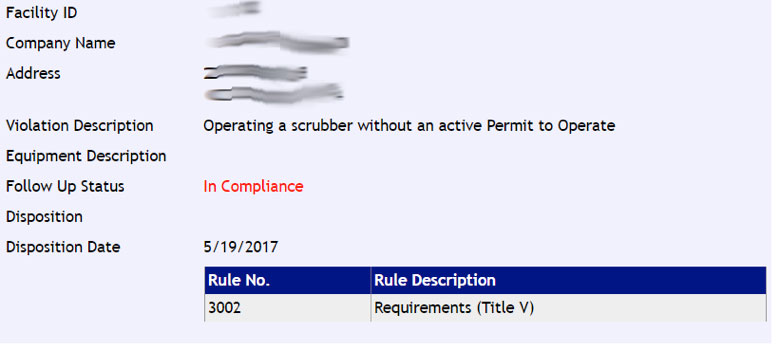 Solution: Keep the SCAQMD updated on any new process or equipment. When a process changes, tell the agency so it can amend your Title V permit.
4. RECLAIM (Rule 2004)
RECLAIM is the SCAQMD's cap-and-trade program for cutting nitrogen oxides and sulfur oxides, known as NOx and SOx. It requires you to report emissions accurately and to hold RECLAIM trading credits equal to or greater than the emissions you report. Like most SCAQMD rules, it also requires recordkeeping and timely reporting. The most common Rule 2004 violation is simply inaccurate emissions reporting.
Inaccurate reporting of emissions
Here, the facility misreported its emissions for the first two quarters of 2011:
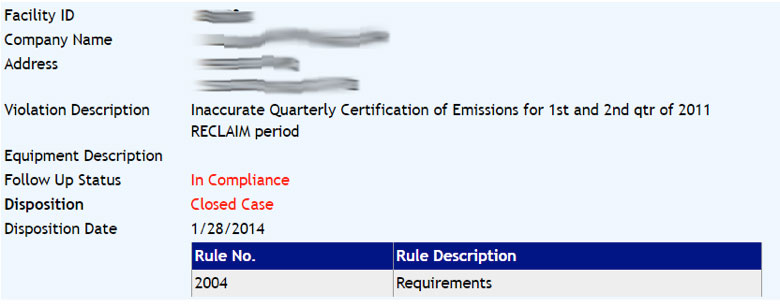 Even a small error, under 1 percent, can result in a Rule 2004 violation. Watch your credit holdings and your emissions through the year so you hold enough credits to cover what you report.
The same data set can be read different ways depending on who's analyzing it. An inspector can arrive at a different number than you reported, and the inspector's interpretation takes precedence. If the two differ, you can be issued an NOV for inaccurate reporting. Solution: Aim for reproducibility. Keep records good enough that someone who knows RECLAIM and your facility can reproduce any emission report you submitted. Document the data, your assumptions, the emission factors, and their sources.
5. Rule 1470
Rule 1470 applies to stationary diesel-fueled engines, such as fire pumps and emergency generators. It requires recordkeeping, emission limits, operating-hour limits, and, for engines near a school, one of the available compliance options. Two violations are common: exceeding emission limits when operating near a school, and failing to record operating hours.
Not meeting emission limits near a school
Here, the facility ran an internal combustion engine within 100 meters of a school and missed the Rule 1470 PM (particulate matter) emission limit:
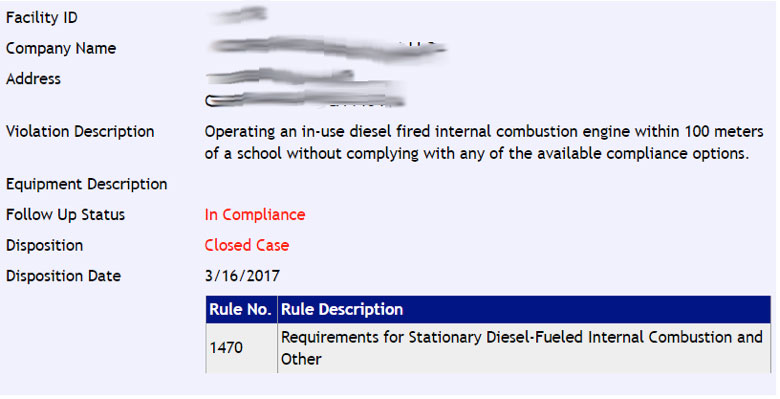 A non-emergency engine within 100 meters of a school cannot operate between 7:30 AM and 4:30 PM on days school is in session, so plan operations around that.
No record of operating hours
Here, the facility kept no record of how long the diesel engine ran:
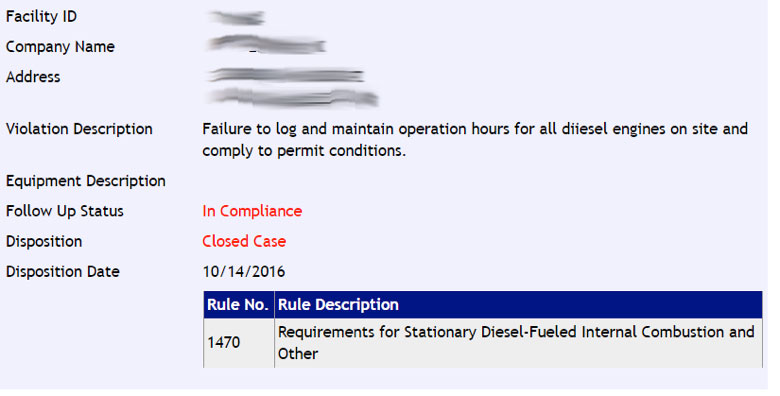 Rule 1470 requires operators to record the times and hours their engine runs.
Solution: Recordkeeping again. Rule 1470 adds two specifics: keep the engine below its hourly limit, and keep the required distance from a school. Know where your equipment stands on both.
Rule 1470 requires operators to record the times and hours their engine runs.
Solution: Recordkeeping again. Rule 1470 adds two specifics: keep the engine below its hourly limit, and keep the required distance from a school. Know where your equipment stands on both.
The SCAQMD has a lot of rules, and they change quickly. You can be in compliance one day and in violation the next without knowing a rule moved. The surest way to stay ahead is to follow the rulemaking process, which is public. If you'd rather not track it yourself, we can keep you in compliance as the rules change.
Let's work together
Get the guidance you need to stay compliant with California's environmental regulations.
Get personalized guidance on your specific compliance situation.
Schedule a Call